


Read the complete guide
This is Rito’s Guide to walking through Santiago with a sense of place. It begins with your arrival, uses A Senra and Alameda to help you get oriented, enters the historic city through O Toural and follows Rúa do Vilar or Rúa do Franco before exploring the Cathedral one square at a time. It then continues to the Market, Cervantes and Bonaval. Rito does not give you a collection of summaries: every chapter explains what you are seeing, why it matters and what to look out for.
Audio guide
Rito’s audio guide, in Spanish.
Rito automatically selects the most natural Spanish voice available on your device.
Spanish voice · automatic selectionArriving in Santiago and getting oriented before you begin
Santiago de Compostela is easier to understand with one simple idea: the intermodal station lies south of the centre; Praza de Galicia and A Senra form its urban entrance; Alameda marks the green edge; and the historic quarter begins as you cross towards Porta Faxeira and O Toural. The Cathedral stands at the heart of this network, but it is not the city’s only destination.
If you arrive by train, you will leave through Santiago–Daniel Castelao station. If you arrive by coach, the terminal forms part of the same complex, although each building has its own exit. Before walking, locate your accommodation, decide what to do with your luggage and check your return departure. Granite paving, slopes and pedestrian streets can be uncomfortable with a large suitcase.
From Rosalía de Castro Airport, the airport’s official information identifies city bus 6A as the connection to Santiago. Check the stop, frequency and any disruption when you land; if you choose a taxi, use the official rank. If you arrive by car, do not make the historic quarter your search area: choose a car park first, save its location and continue on foot.
If you arrive on foot, your entry street will depend on the Camino you followed. Do not consider the day finished as soon as you reach Obradoiro: find a place where you do not block the way, keep your pilgrim passport and documents safe, arrange luggage storage or accommodation, and check the current Pilgrim’s Office procedure if you wish to request the Compostela certificate.
- Train and coach: use Rúa do Hórreo and Praza de Galicia as reference points towards the centre.
- Airport: check bus 6A and the official options on the day you travel.
- Car: park before starting the monumental route.
- Camino: organise your backpack, accommodation and paperwork before sightseeing.
Aparcamiento Plaza Galicia
The most direct option for starting at A Senra, CHUORE and Alameda before entering through O Toural. Confirm availability, height limit, opening hours and price on the operator’s website.
Praza de GaliciaOpen location or source ↗Aparcamiento San Clemente
Located on Avenida de Rodrigo del Padrón, by the National Police station, it is practical for beginning at Obradoiro and the Cathedral.
Avenida de Rodrigo del PadrónOpen location or source ↗Aparcamiento Xoán XXIII
It lets you walk in through San Francisco towards the monumental area without searching for parking inside the historic quarter.
Avenida de Xoán XXIIIOpen location or source ↗Aparcamiento de Belvís
A better fit if you want to begin at the Mercado de Abastos, Belvís or San Domingos de Bonaval; check the gradient of the walking route.
Open location or source ↗Sources used in this chapter
A Senra: the hinge between the historic and modern city
Rúa da Senra is not a medieval postcard, and that is precisely why it helps explain Santiago. It is an everyday link between Praza de Galicia, the Ensanche shopping district, Porta Faxeira and Campo da Estrela. On one side are the shops, services and transport of the modern city; on the other begin Alameda and the historic streets.
Coming from the station, you reach Praza de Galicia and can enter A Senra before climbing towards Porta Faxeira. Leaving Alameda, the street returns you to the city centre without forcing you across the whole historic quarter. Coming down from O Toural, A Senra continues naturally towards Praza de Galicia and Rúa do Hórreo.
CHUORE is at number 20. Its location offers a pause before entering the monumental area or after returning from it, without leaving the station–Alameda–Toural axis. From here, choose one direction and keep to it: Alameda for perspective, Toural to enter the historic city or Praza de Galicia to head back to the station.
The practical point is not to confuse proximity with flat terrain. Santiago is very walkable, but paving can be slippery and some links hide steep sections. In rain, with luggage, a pushchair or reduced mobility, open the exact route before setting out and favour the easiest access.
Towards Alameda
Continue towards Porta Faxeira and enter the park to find Paseo da Ferradura and the views over the historic quarter.
Towards the Cathedral
Walk up to O Toural, follow Rúa do Vilar and enter the Cathedral complex through Praterías.
Towards the station
Head down to Praza de Galicia and use Rúa do Hórreo as the main route back.
Alameda: the balcony from which Santiago starts to make sense
Before entering the maze of stone, go to Alameda. From Paseo da Ferradura you can identify the Cathedral towers, the roofs of the historic quarter and the city’s true scale. It is more than a viewpoint: it is Compostela’s great green sitting room and one of its oldest and best-loved promenades.
What we call Alameda contains three areas: Paseo da Alameda, Carballeira de Santa Susana and Paseo da Ferradura. The oak grove surrounds the chapel of Santa Susana; Ferradura wraps around the hillside and offers several famous views; and the central promenade retains the park’s urban and ceremonial character.
Look for the statues of Maruxa and Coralia Fandiño, known as As Dúas Marías or As Dúas en Punto. Their colourful clothes and daily two-o’clock walk contrasted with the grey Compostela of the dictatorship. The image is cheerful, but their story also speaks of repression, exclusion and everyday resistance; it deserves more than a quick photograph.
Continue towards Paseo dos Leóns and Ferradura. The view changes with the light and rain: at dawn the area is usually calmer, while late-afternoon granite takes on warm tones. When the ground is wet, avoid walking while looking at your phone and watch for leaves, steps and polished surfaces.
Sources used in this chapter
Porta Faxeira, O Toural and Rúa do Vilar: entering stone-built Compostela
From Alameda, cross towards Porta Faxeira and O Toural. This passage acts as a mental gateway: behind you are the avenues of the modern city; ahead begins a network of narrow streets, arcades and squares. O Toural is a useful reference point, letting you choose Rúa do Vilar, Rúa Nova, As Orfas or the route back towards A Senra.
O Toural once hosted livestock sales and supplied water. Its present fountain dates from 1822 and, opposite it, the Baroque façade of Pazo de Bendaña is crowned by Atlas holding up the celestial vault. The building now houses the Eugenio Granell Foundation, devoted to the Galician Surrealist artist.
Enter Rúa do Vilar and look at the upper floors. Its grand houses mix Renaissance, Baroque and Neoclassical periods, with coats of arms, carved stone, ironwork and glazed galleries. The arcades are not scenery: they allowed commerce and pedestrian life to continue in a city accustomed to rain.
Near the far end of the street is the Municipal Tourist Office. You will also find Entrerrúas, a tiny passage identified by Santiago Tourism as the city’s narrowest street. No long detour is needed: simply notice how the medieval layout uses every gap.
Sources used in this chapter
Rúa do Franco and Fonseca: pilgrims, taverns and university life
Rúa do Franco links Porta Faxeira with the Cathedral area and concentrates much of the historic quarter’s hospitality tradition. Its name does not refer to the dictator: it comes from the Franks, a term used for free men or foreigners arriving from beyond the Pyrenees. The first innkeepers settled here to serve people completing the Camino.
The street remains lively, but it is worth seeing as more than a row of bars. Notice the side entrances, signs, façades and the way the route opens into Fonseca and the Cathedral complex. It can be crowded at peak times; parallel Rúa do Vilar is quieter and has more arcades.
Near the upper end stands Colexio de Fonseca, regarded as the birthplace of the University of Santiago. Archbishop Alonso de Fonseca III founded it in 1522 to teach Arts, Theology and Law. Its Renaissance courtyard and former library show that Santiago also grew as a university city.
On one corner of the building is the Tree of Science. Student tradition involved standing with your back to it and randomly pointing at one branch to choose a degree. It is not a reliable oracle—your enrolment deserves a little more thought—but it neatly captures the relationship between Fonseca and generations of students.
Open Porta Faxeira → Rúa do Franco → ObradoiroSources used in this chapter
Praza do Obradoiro: a thousand years of city in one complete turn
Do not look only at the Cathedral. Stand near the centre of the square and turn slowly: Obradoiro brings together religion, government, university and hospitality. To the east is the Cathedral façade; to the west, Pazo de Raxoi; to the south, Colexio de San Xerome; and to the north, the former Royal Hospital, now Hostal dos Reis Católicos.
It also brings together styles built over centuries. The Cathedral’s Baroque façade stands alongside the Neoclassicism of Pazo de Raxoi, the Gothic-to-Renaissance transition of the former hospital and the Renaissance language of San Xerome. Their common granite makes the ensemble harmonious despite those differences.
Pazo de Raxoi was designed as a confessors’ seminary and for civic functions; today it houses City Hall and offices of the Xunta de Galicia. Colexio de San Xerome, home to the University Rectorate, preserves a late-Gothic portal from a former pilgrims’ hospital.
Hostal dos Reis Católicos began as the Royal Hospital for pilgrims. Its façade, courtyards and position opposite the Cathedral remind us that welcome formed part of Santiago’s urban project rather than being a service added centuries later.
The paving looks old, but its present arrangement is relatively recent. Radial paths once helped people cross the mud. The central plaque has become an emotional kilometre zero for many pilgrims, although the Camino continues afterwards in each person’s life.
Sources used in this chapter
The Cathedral outside: four squares, four ways to understand it
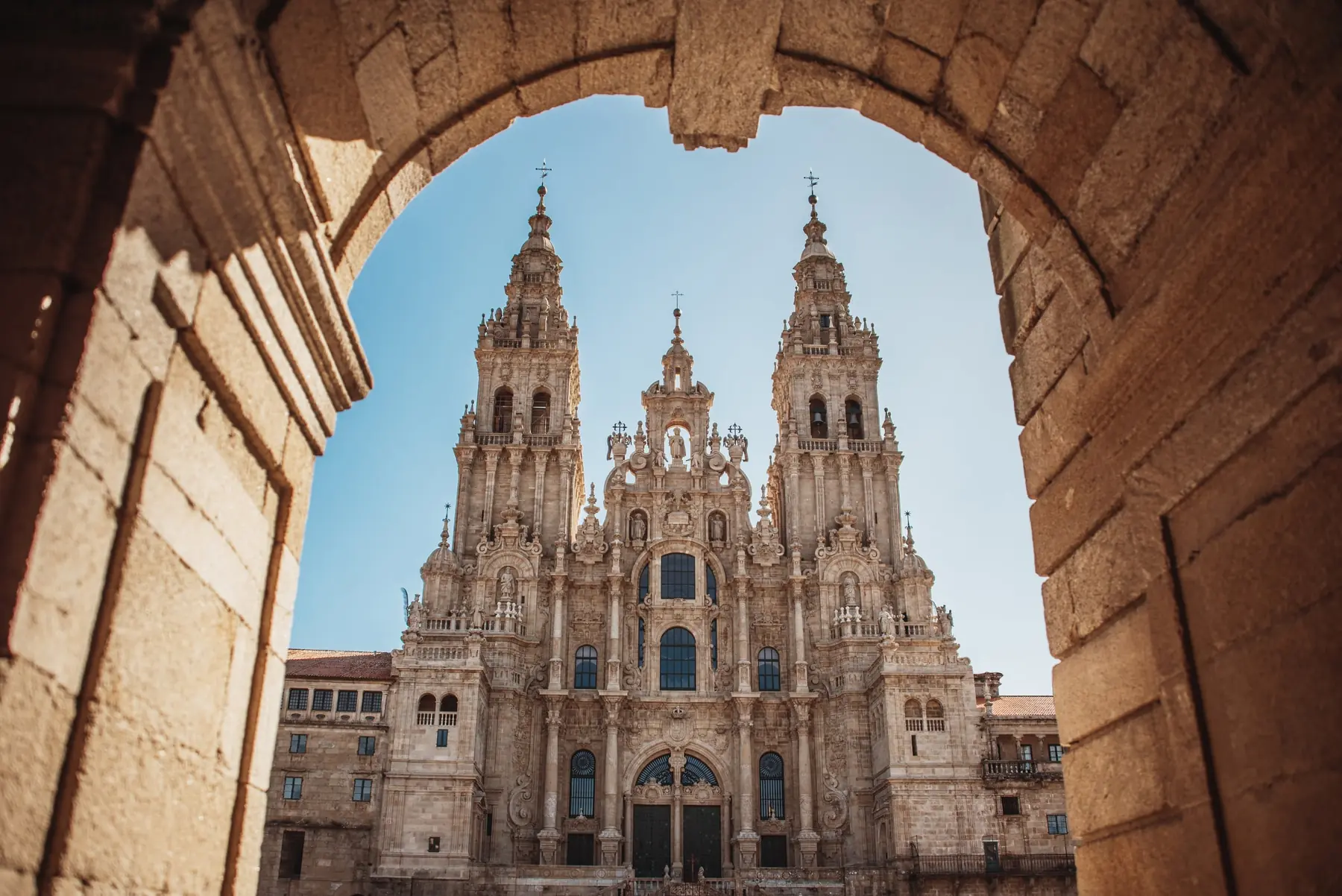
Construction of the present Cathedral began in 1075 and it was consecrated in 1211. Its medieval structure was extended and transformed over centuries to serve a growing pilgrimage. The great Obradoiro façade is Baroque, while behind it remains an essentially Romanesque organisation.
At Obradoiro, notice a façade conceived as an enormous stone altarpiece. The towers reach 74 metres and envelop earlier medieval structures. In the centre appears Saint James dressed as a pilgrim; below, the depiction of the tomb and star recalls the story of the sepulchre’s discovery.
Walk around the church towards Praza da Inmaculada. The final urban section of the French Way arrives here, beside San Martiño Pinario, whose scale visually competes with the Cathedral. This side helps explain the arrival of people entering from Acibechería before reaching Obradoiro.
At Quintana, the great staircase symbolically separates Quintana de Vivos from Quintana de Mortos, a name linked to the former cemetery. The Holy Door opens only in Holy Years. Opposite, San Paio de Antealtares has a long façade of barred windows and is still home to a cloistered Benedictine community.
At Praterías you will see the Cathedral’s only surviving Romanesque façade. Its sculpture was rearranged after damage and alterations, so some figures look like pieces of a great medieval puzzle. Look for David playing an instrument, scenes from the Passion and the Fountain of the Horses in the middle of the square.
Do not treat the four squares as mere photo backdrops. Each explains a role: Obradoiro’s public arrival, the Camino at Inmaculada, the funerary and liturgical memory of Quintana, and the Romanesque language of Praterías.
Open the route around the Cathedral’s four squaresSources used in this chapter
Inside the Cathedral: what you are seeing and why it matters
Before entering, distinguish worship from a cultural visit. Access to the church, services, Museum, Portico of Glory, rooftops and night visits all have different conditions. Check the official website, have your ticket ready where required and respect luggage and photography controls.
The plan is a Latin cross and follows the model of a pilgrimage church: three longitudinal naves, a transept and an ambulatory that allows people to move around the high altar. The long, lofty central nave preserves the restraint of Romanesque stone despite later additions.
The Portico of Glory was carved by Master Mateo between 1168 and 1188. More than two hundred figures create a theological vision led by Christ and Saint James. This is not a collection of isolated statues: gestures, instruments, glances and positions form a narrative that welcomed pilgrims at the end of the Camino.
For centuries, people placed a hand on the central column and bumped their head against the figure known as Santo dos Croques to ask for talent. Those customs damaged the work and must no longer be followed. The best way to respect the Portico is to observe it without touching and follow conservation instructions.
Beneath the high altar is the crypt linked to the tradition of the Apostle’s tomb. Embracing the statue of Saint James, when access is open, forms part of popular devotion. Not every visitor follows these rituals: the space can also be explored through its history, architecture and cultural meaning.
The Botafumeiro is a large censer used at certain solemnities and services. It is not a show with guaranteed daily performances. If seeing it matters to your visit, check the official liturgical calendar and remember that any ceremonial change takes priority over a sightseeing plan.
The Museum explains the evolution of the building, its collections and related spaces. The rooftops offer an exceptional reading of the city layout, but require a ticket and punctuality; the Portico and other themed visits have their own capacity and timetable.
Sources used in this chapter
Mercado de Abastos: Galicia explained through its food
Mercado de Abastos is worth visiting even if you do not plan to buy. It offers three readings in one place: architecture, food culture and everyday life. Its halls bring together fish and shellfish, meat, cheese, bread, vegetables, flowers and other Galician products, with activity that changes by day and time.
In the Middle Ages, sellers were spread across different squares, including Praterías, Azabachería and Cervantes. At the end of the 19th century this activity was brought together in the former gardens of the Count of Altamira. The present building was constructed in 1941 to a design by Joaquín Vaquero Palacios.
The sequence of granite halls recalls traditional Galician architecture and separates trades and products. Walk through without blocking stalls, remember that this is a working market and ask permission before photographing vendors or customers close up.
Morning usually offers more atmosphere, but do not set a time from an old guide. Sundays and public holidays can completely change the level of activity; check the Market website before planning the visit or making a special journey.
From the Market, continue towards Praza de Cervantes and San Martiño Pinario, return to the Cathedral or head on to the Centro Galego de Arte Contemporánea and Bonaval. It is a good place to leave monumentality behind for a while and watch the city shop, talk and cook.
Open Cathedral → Mercado de AbastosSources used in this chapter
Cervantes, A Troia and San Martiño Pinario: the city that studied and traded
Praza de Cervantes was a commercial and civic space for centuries. Its position links the Market, Casas Reais, Acibechería and university streets. Instead of crossing in a hurry, use it to observe arcades, façades and the everyday movement of the historic quarter.
Nearby is Casa da Troia, linked to Alejandro Pérez Lugín’s novel and the memory of student boarding houses. Its interest is not only literary: it helps us imagine a city where students from elsewhere shared rooms, meals and academic life within the historic quarter.
San Martiño Pinario has a monumental scale opposite the Cathedral’s north façade. The Benedictine complex grew into one of Spain’s largest monasteries. Check which areas can be visited and their hours, because church, museum, guesthouse and other uses do not operate as a single freely accessible visit.
This part of the route explains why Compostela cannot be reduced to pilgrimage. The University, markets, monasteries and administration produced a lived-in city with its own conflicts, trades, accommodation and routines.
To return from Praza de Cervantes towards A Senra and CHUORE, Rito suggests an easy sequence: Rúa do Preguntoiro, Fonte de Santo Antonio, Rúa das Orfas, Praza do Toural and Rúa da Senra. This brings you back to the Alameda and Praza de Galicia axis using clear landmarks.
Open Cervantes → Orfas → Toural → CHUORESources used in this chapter
Bonaval, Centro Galego de Arte Contemporánea and Museo do Pobo Galego
East of the historic quarter, San Domingos de Bonaval brings together three layers: the former convent, Museo do Pobo Galego and Centro Galego de Arte Contemporánea. Together they lead from traditional culture to contemporary creation without leaving the same urban setting.
The park occupies the former Dominican orchard and cemetery. Isabel Aguirre and Álvaro Siza’s intervention respected the slope, oak grove, walls and previous uses while adding paths and terraces. This is not a flat garden: climb slowly and adapt the visit when the ground is wet.
Look for Eduardo Chillida’s Puerta de la Música. The very heavy sculpture is positioned to frame a view of the city. Stand behind it and understand the work as a device for looking, not simply an object to photograph from the front.
The former cemetery retains a distinctive atmosphere and has hosted cultural activities because of its acoustics. Water appears in fountains, channels and small tanks; fruit trees and the oak grove accompany the climb towards increasingly open views.
In heavy rain, prioritise the Centro Galego de Arte Contemporánea and Museo do Pobo Galego and leave the park for a break in the weather. On a clear day, Bonaval makes a fine ending because it shows the historic city from a less obvious perspective than Alameda.
Open Market → museums → BonavalSources used in this chapter
How to continue: one day, rain, students, pilgrims and nights in Santiago
If you have only one day, do not try to complete every museum. Start in Alameda, enter through Toural and Rúa do Vilar, give real time to the Cathedral and its squares, continue to the Market and choose Cervantes–San Martiño or Bonaval according to your interests. Leave time to sit down and for entrances that require a booking.
In rain, group indoor places by area. The Cathedral and Museum form one group; the Market and Museo das Peregrinacións another; Centro Galego de Arte Contemporánea and Museo do Pobo Galego a third. Arcades help, but do not form a fully covered route. Wet granite calls for shoes with grip and less attention to your screen.
If you stay overnight, choose an area according to your arrival and the next day: the historic quarter for monumental immersion; Hórreo and the intermodal station for connections; Alameda and Ensanche for balance; San Pedro, Belvís or Bonaval for neighbourhood atmosphere and the Camino entrance. Check noise, gradient, car access and luggage storage before booking.
Students should first locate their specific faculty: Campus Vida, Campus Norte and the historic buildings are not in the same place. Pilgrims should prioritise rest, backpack, accommodation, the Pilgrim’s Office and health before adding sightseeing. Each of these situations has a detailed guide linked in the menu at the start of the guide.