

Praza de Cervantes was a commercial and civic space for centuries. Its position links the Market, Casas Reais, Acibechería and university streets. Instead of crossing in a hurry, use it to observe arcades, façades and the everyday movement of the historic quarter.
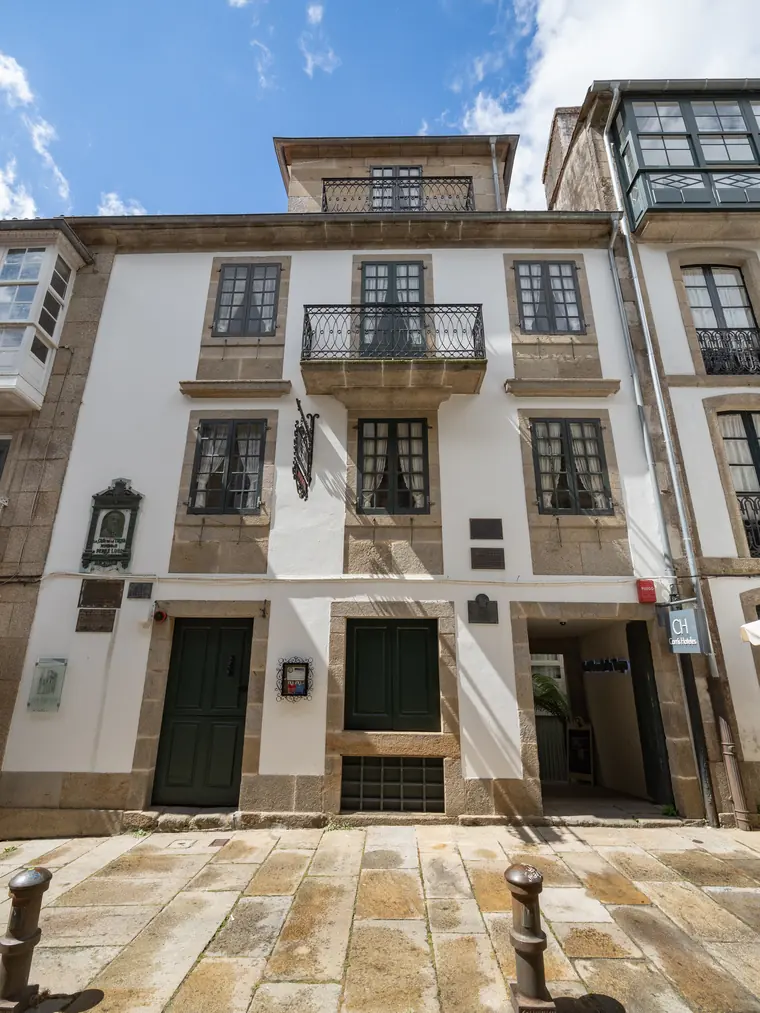
Nearby is Casa da Troia, linked to Alejandro Pérez Lugín’s novel and the memory of student boarding houses. Its interest is not only literary: it helps us imagine a city where students from elsewhere shared rooms, meals and academic life within the historic quarter.
San Martiño Pinario has a monumental scale opposite the Cathedral’s north façade. The Benedictine complex grew into one of Spain’s largest monasteries. Check which areas can be visited and their hours, because church, museum, guesthouse and other uses do not operate as a single freely accessible visit.
This part of the route explains why Compostela cannot be reduced to pilgrimage. The University, markets, monasteries and administration produced a lived-in city with its own conflicts, trades, accommodation and routines.
To return from Praza de Cervantes towards A Senra and CHUORE, walk through the cathedral squares and follow Rúa do Vilar to O Toural. Continue from there to Rúa da Senra. The map for this stop follows the same landmarks.
Audio guide
Listen to the walk in Spanish as you explore. Pause and continue whenever you like.
Spanish voice · automatic selectionSources used in this chapter
Frequently asked questions
What can I see here?
Praza de Cervantes was a commercial and civic space for centuries. Its position links the Market, Casas Reais, Acibechería and university streets. Instead of crossing in a hurry, use it to observe arcades, façades and the everyday movement of the historic quarter.
How do I get there?
Praza de Cervantes · Casa da Troia · San Martiño Pinario. Follow the walking route for this stop
How much time should I allow for the visit?
30–60 min (suggested)
What should I check before I go?
Cervantes · Casa da Troia · San Martiño