

Rúa do Franco links Porta Faxeira with the Cathedral area and concentrates much of the historic quarter’s hospitality tradition. Its name does not refer to the dictator: it comes from the Franks, a term used for free men or foreigners arriving from beyond the Pyrenees. The first innkeepers settled here to serve people completing the Camino.
The street remains lively, but it is worth seeing as more than a row of bars. Notice the side entrances, signs, façades and the way the route opens into Fonseca and the Cathedral complex. It can be crowded at peak times; parallel Rúa do Vilar is quieter and has more arcades.
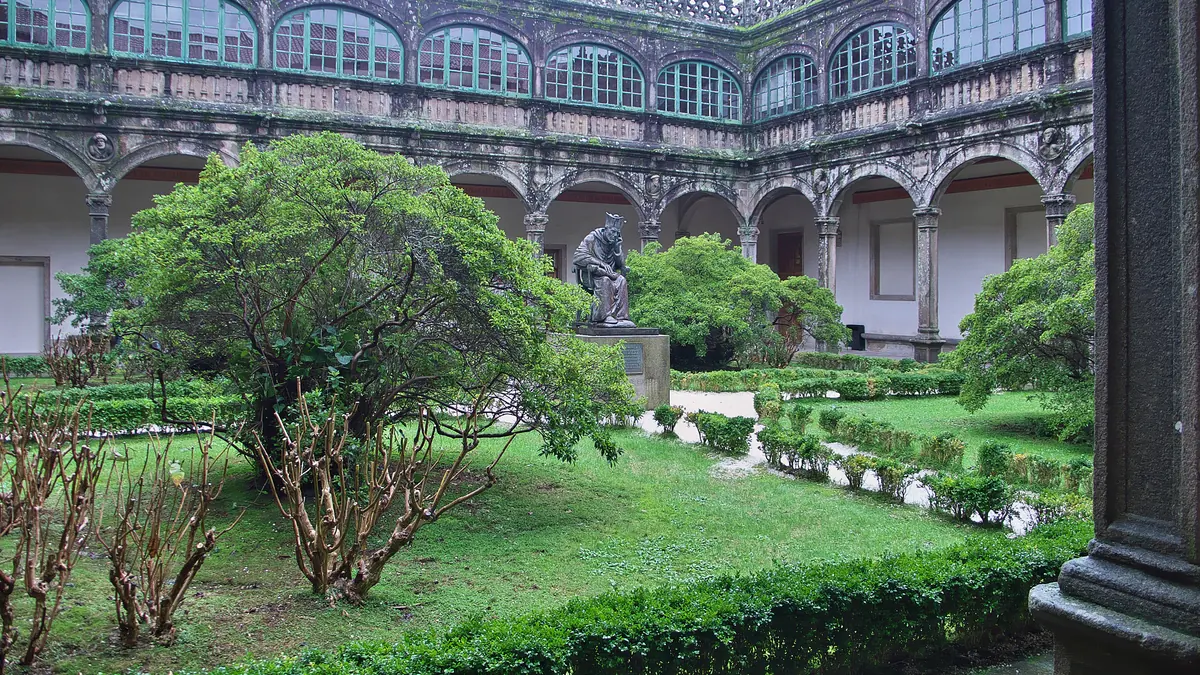
Near the upper end stands Colexio de Fonseca, regarded as the birthplace of the University of Santiago. Archbishop Alonso de Fonseca III founded it in 1522 to teach Arts, Theology and Law. Its Renaissance courtyard and former library show that Santiago also grew as a university city.
On one corner of the building is the Tree of Science. Student tradition involved standing with your back to it and randomly pointing at one branch to choose a degree. It is not a reliable oracle—your enrolment deserves a little more thought—but it neatly captures the relationship between Fonseca and generations of students.
Audio guide
Listen to the walk in Spanish as you explore. Pause and continue whenever you like.
Spanish voice · automatic selectionSources used in this chapter
Frequently asked questions
What can I see here?
Rúa do Franco links Porta Faxeira with the Cathedral area and concentrates much of the historic quarter’s hospitality tradition. Its name does not refer to the dictator: it comes from the Franks, a term used for free men or foreigners arriving from beyond the Pyrenees. The first innkeepers settled here to serve people completing the Camino.
How do I get there?
Rúa do Franco · Colexio de Fonseca. Follow the walking route for this stop
How much time should I allow for the visit?
20–30 min (suggested)
What should I check before I go?
Rúa do Franco · Fonseca