

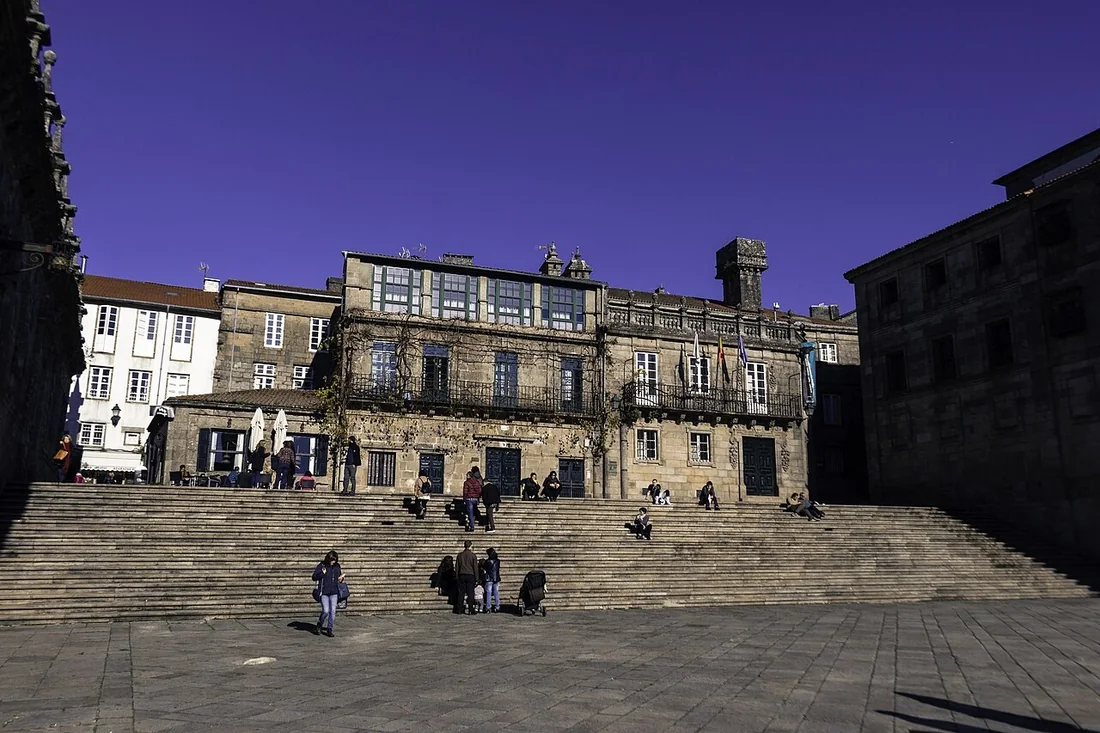
Praza da Quintana
Walk around the Cathedral through this two-level square. The broad steps give you a different view of its façades.
Construction of the present Cathedral began in 1075 and it was consecrated in 1211. Its medieval structure was extended and transformed over centuries to serve a growing pilgrimage. The great Obradoiro façade is Baroque, while behind it remains an essentially Romanesque organisation.
At Obradoiro, notice a façade conceived as an enormous stone altarpiece. The towers reach 74 metres and envelop earlier medieval structures. In the centre appears Saint James dressed as a pilgrim; below, the depiction of the tomb and star recalls the story of the sepulchre’s discovery.
Walk around the church towards Praza da Inmaculada. The final urban section of the French Way arrives here, beside San Martiño Pinario, whose scale visually competes with the Cathedral. This side helps explain the arrival of people entering from Acibechería before reaching Obradoiro.
At Quintana, the great staircase symbolically separates Quintana de Vivos from Quintana de Mortos, a name linked to the former cemetery. The Holy Door opens only in Holy Years. Opposite, San Paio de Antealtares has a long façade of barred windows and is still home to a cloistered Benedictine community.
At Praterías you will see the Cathedral’s only surviving Romanesque façade. Its sculpture was rearranged after damage and alterations, so some figures look like pieces of a great medieval puzzle. Look for David playing an instrument, scenes from the Passion and the Fountain of the Horses in the middle of the square.
Do not treat the four squares as mere photo backdrops. Each explains a role: Obradoiro’s public arrival, the Camino at Inmaculada, the funerary and liturgical memory of Quintana, and the Romanesque language of Praterías.
Read Rito’s stopFrequently asked questions
What can I see here?
Construction of the present Cathedral began in 1075 and it was consecrated in 1211. Its medieval structure was extended and transformed over centuries to serve a growing pilgrimage. The great Obradoiro façade is Baroque, while behind it remains an essentially Romanesque organisation.
How do I get there?
Praza da Quintana, Santiago de Compostela. Follow the walking route for this stop
How much time should I allow for the visit?
30–45 min (suggested)
What should I check before I go?
Four outdoor squares